Dado
Overview
Dado is a domain-specific decision engine designed to evaluate strategic career pivots within the built environment. It replaces keyword matching with structured role modeling, weighted scoring logic, and trajectory-aware fit evaluation.
Categories
0 → 1
SaaS
Strategy
AI Systems
Date
Client
Dado

Problem
Statement
Built environment professionals navigating transitions into tech face unclear role translation, inconsistent seniority mapping, and ambiguous long-term trajectory outcomes. Most job platforms evaluate surface-level skill overlap, not structural career alignment.
High-stakes career decisions are made with incomplete information.

Process
Dado was developed through structured domain analysis of AEC role nuance, progression patterns, and pivot pathways into tech.
The product architecture was built in layers:
Role normalization across firm types and sectors
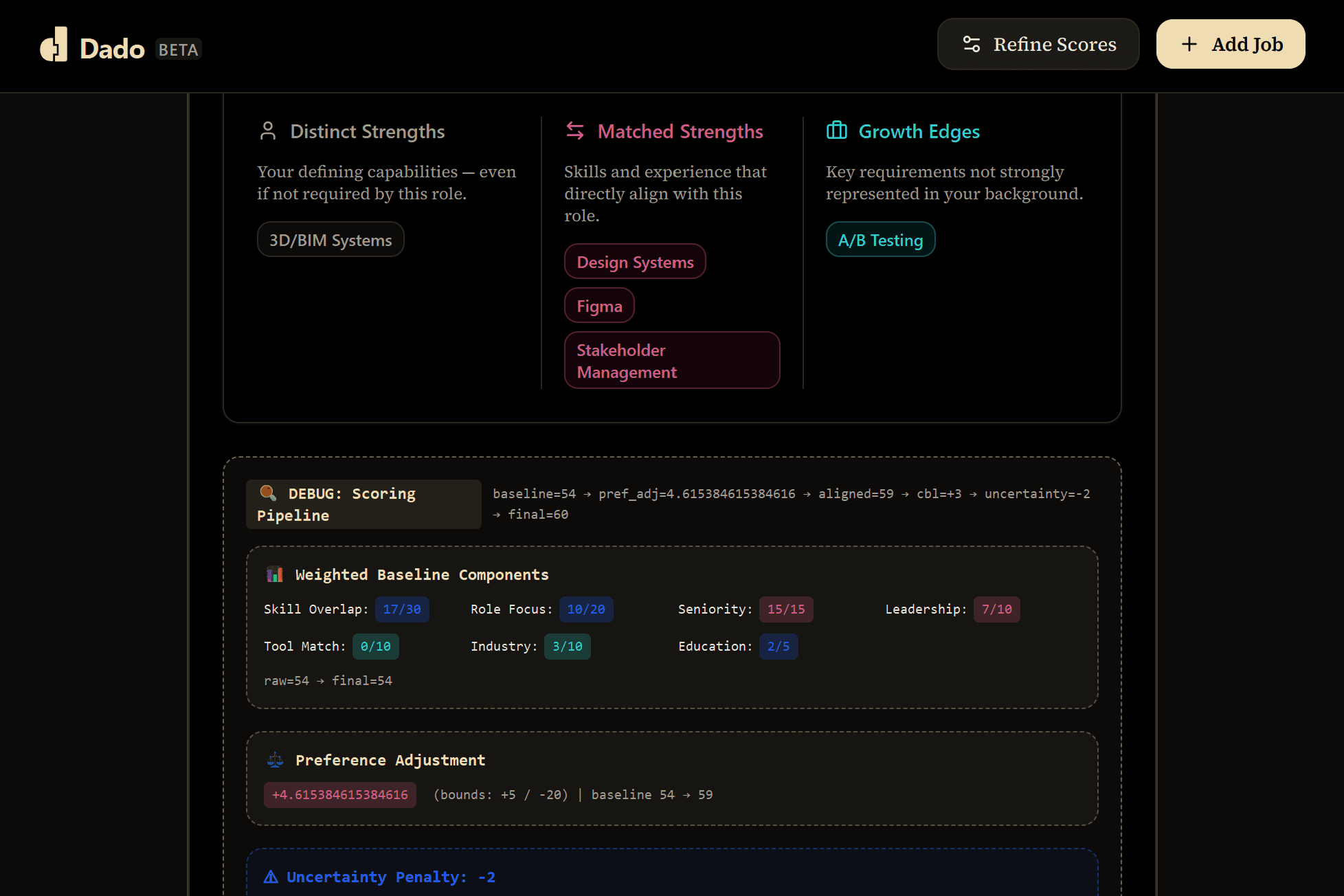
Structural baseline scoring
Preference-weighted adjustments
Contextual boost layer
Guardrails for non-negotiables
Dual alignment outputs (“Role Fit for You” and “Your Fit for Role”)
The scoring framework is iteratively refined to improve precision, consistency, and explainability.

Solution
A domain-specific decision engine designed to evaluate strategic career pivots within the built environment and adjacent tech sectors.
The system generates dual alignment metrics by evaluating:
Structural responsibility alignment
Leadership and technical depth translation
Compensation trajectory implications
Long-term progression impact
Rather than relying on keyword overlap, the engine applies layered scoring logic to produce explainable, trajectory-aware outputs.

Results &
Impact
Currently in active refinement, with ongoing iteration of its scoring architecture and trajectory modeling logic.
Early testing has validated the importance of:
Domain-specific role normalization
Weighted preference modeling
Transparent, explainable outputs
The product continues to evolve toward a structured infrastructure for evaluating high-stakes career decisions within the built environment.
Dado
Overview
Dado is a domain-specific decision engine designed to evaluate strategic career pivots within the built environment. It replaces keyword matching with structured role modeling, weighted scoring logic, and trajectory-aware fit evaluation.
Categories
0 → 1
SaaS
Strategy
AI Systems
Date
Client
Dado
Problem
Statement
Built environment professionals navigating transitions into tech face unclear role translation, inconsistent seniority mapping, and ambiguous long-term trajectory outcomes. Most job platforms evaluate surface-level skill overlap, not structural career alignment.
High-stakes career decisions are made with incomplete information.
Process
Dado was developed through structured domain analysis of AEC role nuance, progression patterns, and pivot pathways into tech.
The product architecture was built in layers:
Role normalization across firm types and sectors
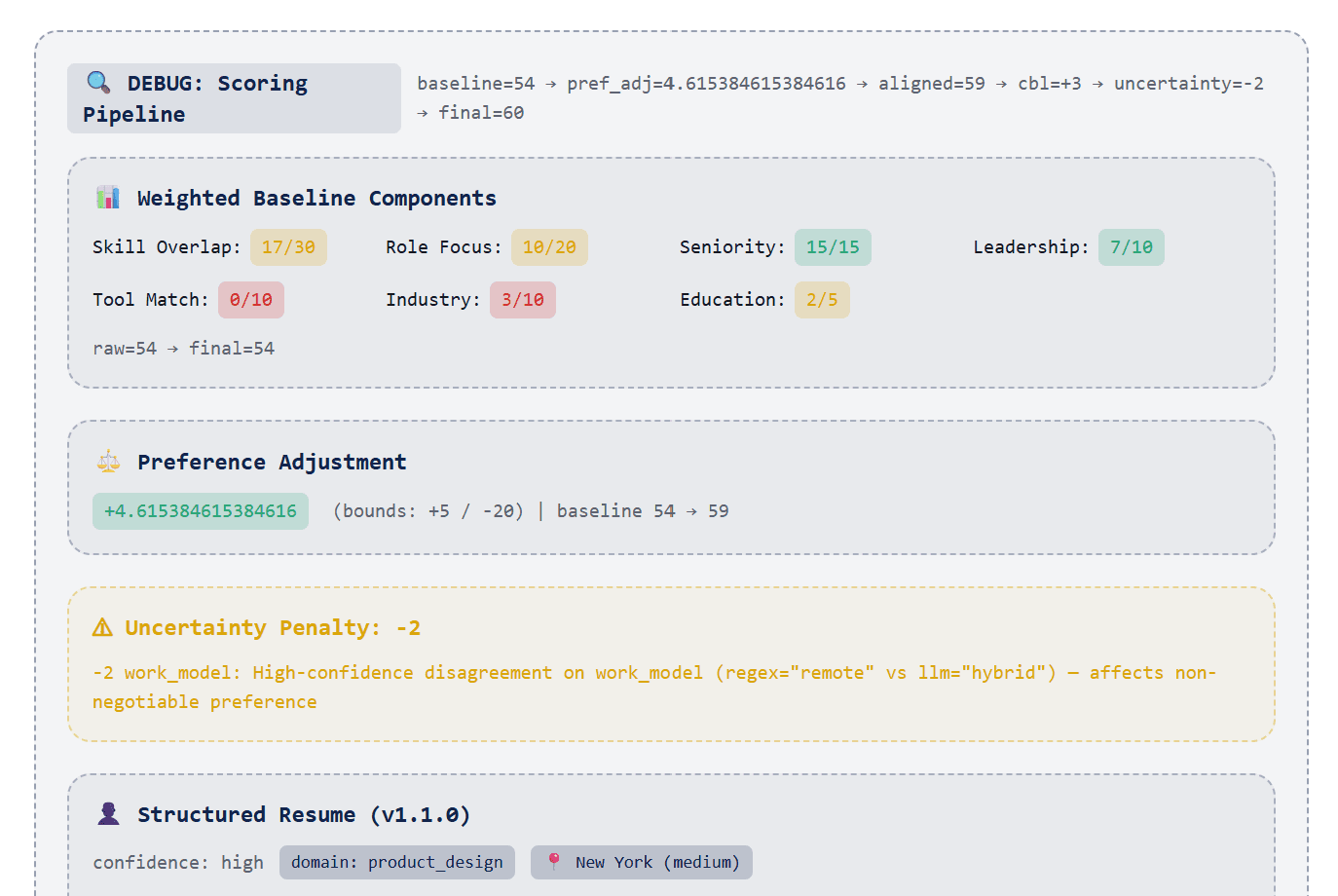
Structural baseline scoring
Preference-weighted adjustments
Contextual boost layer
Guardrails for non-negotiables
Dual alignment outputs (“Role Fit for You” and “Your Fit for Role”)
The scoring framework is iteratively refined to improve precision, consistency, and explainability.
Solution
A domain-specific decision engine designed to evaluate strategic career pivots within the built environment and adjacent tech sectors.
The system generates dual alignment metrics by evaluating:
Structural responsibility alignment
Leadership and technical depth translation
Compensation trajectory implications
Long-term progression impact
Rather than relying on keyword overlap, the engine applies layered scoring logic to produce explainable, trajectory-aware outputs.
Results &
Impact
Currently in active refinement, with ongoing iteration of its scoring architecture and trajectory modeling logic.
Early testing has validated the importance of:
Domain-specific role normalization
Weighted preference modeling
Transparent, explainable outputs
The product continues to evolve toward a structured infrastructure for evaluating high-stakes career decisions within the built environment.
Dado
Overview
Dado is a domain-specific decision engine designed to evaluate strategic career pivots within the built environment. It replaces keyword matching with structured role modeling, weighted scoring logic, and trajectory-aware fit evaluation.
Categories
0 → 1
SaaS
Strategy
AI Systems
Date
Client
Dado
Problem
Statement
Built environment professionals navigating transitions into tech face unclear role translation, inconsistent seniority mapping, and ambiguous long-term trajectory outcomes. Most job platforms evaluate surface-level skill overlap, not structural career alignment.
High-stakes career decisions are made with incomplete information.
Process
Dado was developed through structured domain analysis of AEC role nuance, progression patterns, and pivot pathways into tech.
The product architecture was built in layers:
Role normalization across firm types and sectors
Structural baseline scoring
Preference-weighted adjustments
Contextual boost layer
Guardrails for non-negotiables
Dual alignment outputs (“Role Fit for You” and “Your Fit for Role”)
The scoring framework is iteratively refined to improve precision, consistency, and explainability.
Solution
A domain-specific decision engine designed to evaluate strategic career pivots within the built environment and adjacent tech sectors.
The system generates dual alignment metrics by evaluating:
Structural responsibility alignment
Leadership and technical depth translation
Compensation trajectory implications
Long-term progression impact
Rather than relying on keyword overlap, the engine applies layered scoring logic to produce explainable, trajectory-aware outputs.
Results &
Impact
Currently in active refinement, with ongoing iteration of its scoring architecture and trajectory modeling logic.
Early testing has validated the importance of:
Domain-specific role normalization
Weighted preference modeling
Transparent, explainable outputs
The product continues to evolve toward a structured infrastructure for evaluating high-stakes career decisions within the built environment.




Book a call, and I’ll take care of the rest
© 2026 All rights reserved
Book a call, and I’ll take care of the rest
© 2026 All rights reserved
Book a call, and I’ll take care of the rest
© 2026 All rights reserved